


15, B.B.D. Bag, Kolkata-700 001 : Sunday Worship Service Timing 9:30am
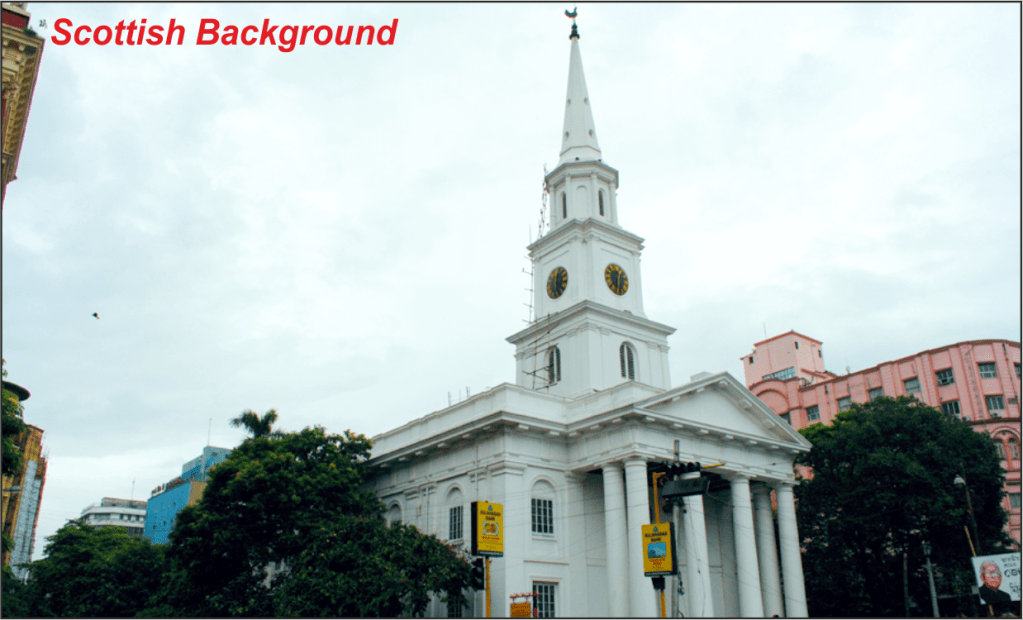
Calcutta’s streets seldom generate the feeling that ours is or was a planned city, but this is not so when riding or walking northwards along the Red Road. The handsome Grecian building of St. Andrew’s Church with a slender spire seems to be located strategically to welcome the traveler at the end of his journey. The foundation stone of the Church was laid on St. Andrew’s Day, 30th November, in 1915 when the Countess of Loudon and Moria was present. Among the local people, the Church was formerly known as “Lat-Sahib-Ka-Girja”. Today it also goes by the local name of “Murji-Church”, due to the presence of a weather cock atop its high spire.
Situated at the Lalbazar corner of Dalhousie Square, St. Andrew’s Church (or Scottish Kirk) is the senior Church of Scotland in Bengal. It began as a church for the Scottish Presbyterian Christians in the East India Company ruled India. The Charter Act, passed in 1813 allowed the chaplains and missionaries to work in India. The Rev. Dr. Alexander Duff too provided services for a short time in its early days.
The Scottish congregation was formed in 1815 by Dr. James Bryce and the services were conducted initially in the Asiatic Society Hall. As time went by there were three separate congregations representing the various Scottish Church denominations, namely, the Wellesley Square United Free Church, the River Parish Bengal Mills and Steamers Association in addition to St. Andrew’s Church. These three came together in a remarkable church union in 1942 and merged with St. Andrew’s Church.
Another union came about when the Church of Scotland under United Church of North India (UCNI) accepted the union of churches of the Church of North India.
The St. Andrew’s Church accepted the union but was allowed to retain its distinct form of worship and administration with deacons and elders. Today the St. Andrew’s Church continues to be a part of the CNI, but with its distinct Scottish Presbyterian form of service and Holy Communion. Nec Tamen Consumebatur (Burning but not consumed).
On the north and south of the building are elegant porticos with Doric pillars. The wrought iron fencing is a period piece, worthy of a close inspection. Built by Messrs. Burn, Currie & Co, the Church was opened for public worship on March 8, 1818.
Bishop Middleton, the first Bishop of Calcutta, tried to prevent the erection of the spire of this church because he believed that only the Church of England had the monopoly of spires even in India. Not only did the spire come up, but also on top of it was placed a weather cock. The tower of the Church is more than one hundred and fifty years old and bears testimony to the fact that age has not diminished the glory of this church.
St. Andrew’s Church is the only air conditioned CNI Church in Bengal today. Dalhousie Square consisting of GPO (General Post Office), Writer’s Building, St. Andrew’s Church and many other buildings was declared Heritage of Calcutta. IMTACH volunteered to paint and carry out minor repairs wherever required. In addition, this church was fitted with powerful lights externally.


St. Paul’s Cathedral(Between 1858 – 1861); St. Johns’ Church, Consecrated on 24 June 1787; Union Chapel(1821); St. Andrew’s Church(Opened for public worship on 8 March 1818); Calcutta Hill Christian Church; CNI Wesleyan Church; St. Stephen’s Church, Kidderpore, Consecrated in 1846); St. Thomas’ Church, Mirza Ghalib Street(Opened for public Worship on November 20th 1831); St. Barnabas’ Church, Consecrated on 23rd December’ 1867; St. James Church, Kolkata, Consecrated on 25th July 1864; St. Thomas’ Church, Howrah, Consecrated in 1832; St. Luke’s Church, Bosekati; Sadhu Sundar Singh Girja, Bankra; Christ Church, Liluah (Hindi); Christ Church, Liluah (Bengali); Church of the Epiphany, Established in 1863; Jibon Jyoti Upasanaloy; St. Bartholomew’s Church; St. Johns Church Nahazari; St. Peter’s Church, Inaugurated on 20th June, 1945; St. Nicholas Church; Oxford Mission Chapel; Prabhu Jishu Mandir (Geonkhali); St. Mary’s Church, Consecrated on 16th February, 1889; Duff Church, Established in 1848; Christ Church Kolkata, Dedicated in 1839; St. George’s Church; Dedicated on 1st January 1936; Holy Trinity Church, (Opened for public Worship in November,1826); Emmanuel Church, Krishnapur, Established in 1829; St. James’ Church Baranagar; Serampore Johnnagar Church founded in 1880; Chinsurah Church, founded in 1825; St. Saviour’s Hindi Church, built in 1449; St. Saviour’s Tamil Church, started functioning in 1860; Bhowanipore Congregational Church; Osmond Memorial Church, founded in 1868;