


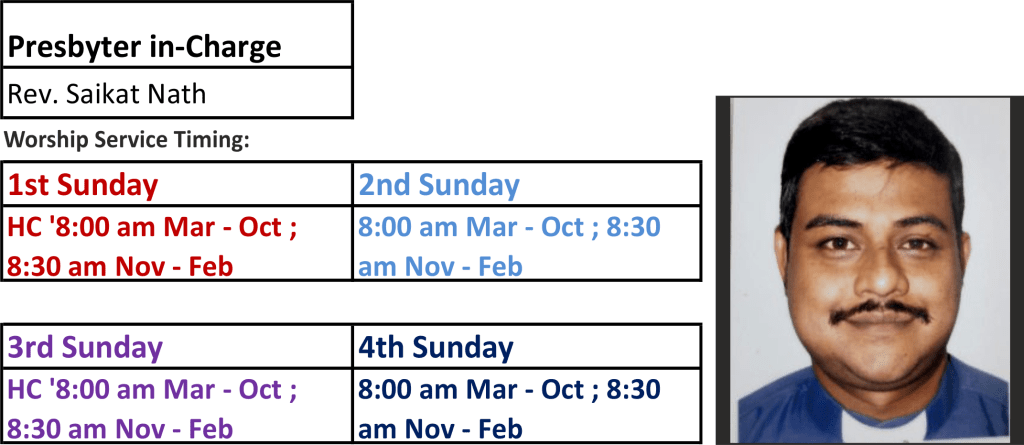
33-B, Amherst Street, Kolkata-700 009 : Sunday Worship Service Timing – March to October 8:00 am and November to February 8:00 am
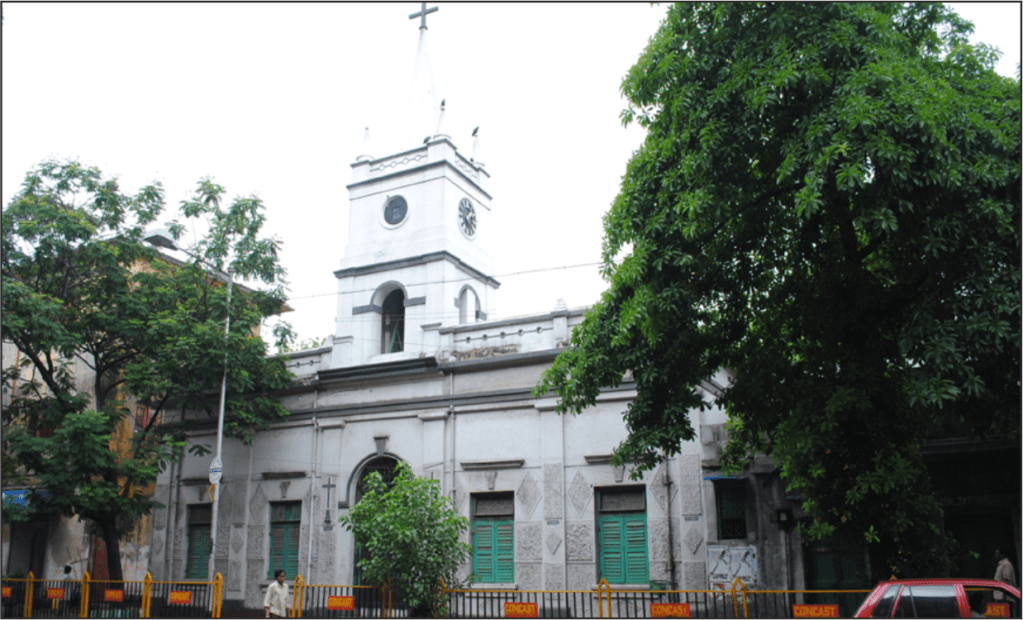
The Ven’ble Archdeacon Corrie, who became the Bishop of Madras, founded the Holy Trinity Church. He came to India as A Chaplain in 1806. In 1820, on the recommendation of Mr. Pratt, the then Secretary of the Church Missionary Society, the Calcutta Committee purchased an estate in Mirzapore (Amherst Street) with Rs 20,400/-. This site had previously been occupied by a tannery. The neighbourhoods was uncongenial and insecure. There was once even a dense forest and an unhygienic tank, which the Holy Trinity Church is now situated. In 1823, a new street was constructed, close to the premises of the church, which converted an unhealthy swamp into a dry healthy residential area. Adjacent to this site Archdeacon Corrie laid the foundation stone of the Holy Trinity Church. It was opened for divine service by Rev. Deer in November,1826. It was the first Church in Bengal in which the liturgy was read in Bengali. It was designed at the outset as a chapel and was known as “CMS Chapel” for many years. Later the choir-seats and altar were added to the original building. As the Church was founded by Corrie, this Church was known among the local people as “Corrie Church” until 1887 and the street to the south side of the estate was known as Corrie Church Lane until it was renamed as Dr. Kartik Bose Street. Later the Church was known as Long Saheb-ka girja for a long time due to the fact that the famous Rev. James Long was associated with this Chapel and St Paul’s College and School. Rev. James Long is still remembered and revered by the people of Bengal for his association and active participation in siding with the Indians in the anti-indigo plantation movement in Bengal, albeit he was a British citizen. He had published the English translation of the anti-indigo planters well known Bengali play ‘Nil Darpan’ by Dinabandhu Mitra and was sent to jail for libel. One of the roads in Kolkata is named after Rev. James Long called James Long Sarani Sarani in South Kolkata.
The entrance to this ash coloured Church is from the west. There is a big clock on either side of the Church steeple. In one corner of the rectangle prayer hall is a circular font built of marble, where children are baptised and christened. Elders are baptised on a square font, placed in another corner of the hall. Inside the Church rooms are memorials erected to honour the contributions of its distinguished devotees, including that of James Long.
The Church is enclosed by St. Paul’s College on one side and the chapel of the city’s first school for girls, on the other side. Sri Ramkrishna Dev of Dakshineswar, after whom Ramkrishna Mision was established, also visited this Church with one of his devotees, Mathura Mohan Biswas and asked his followers to visit this “Holy Place”. From its very inception, the Church Missionary Society ran this Church. Since 1874 the Priest-in-Charge has always been an Indian. Before the unification of the Church of North India it was an Anglican Church. The roof of the Church was badly damaged in 2003. So the roof has been recast and the Church was thoroughly repaired and renovated. The floor of the Church was covered with marble stone. All this work took one year to complete. On 12th December 2004, the Church was rededicated by the Rt. Rev. P. S. P. Raju, the Bishop of Calcutta. The non-Christian people of the city have all along revered the Church. They often attend the church service and also attend festival services.
Holy Trinity Church still upholds its long and glorious heritage. At present, more than sixty families comprising three hundred fifty members including children are living in the Church campus and there are another three hundred members living outside the Church in different parts of the city. The members are engaged in different social work jointly with the neighbouring churches and participate in the various programmes of the Diocese.

St. Paul’s Cathedral(Between 1858 – 1861); St. Johns’ Church, Consecrated on 24 June 1787; Union Chapel(1821); St. Andrew’s Church(Opened for public worship on 8 March 1818); Calcutta Hill Christian Church; CNI Wesleyan Church; St. Stephen’s Church, Kidderpore, Consecrated in 1846); St. Thomas’ Church, Mirza Ghalib Street(Opened for public Worship on November 20th 1831); St. Barnabas’ Church, Consecrated on 23rd December’ 1867; St. James Church, Kolkata, Consecrated on 25th July 1864; St. Thomas’ Church, Howrah, Consecrated in 1832; St. Luke’s Church, Bosekati; Sadhu Sundar Singh Girja, Bankra; Christ Church, Liluah (Hindi); Christ Church, Liluah (Bengali); Church of the Epiphany, Established in 1863; Jibon Jyoti Upasanaloy; St. Bartholomew’s Church; St. Johns Church Nahazari; St. Peter’s Church, Inaugurated on 20th June, 1945; St. Nicholas Church; Oxford Mission Chapel; Prabhu Jishu Mandir (Geonkhali); St. Mary’s Church, Consecrated on 16th February, 1889; Duff Church, Established in 1848; Christ Church Kolkata, Dedicated in 1839; St. George’s Church; Dedicated on 1st January 1936; Holy Trinity Church, (Opened for public Worship in November,1826); Emmanuel Church, Krishnapur, Established in 1829; St. James’ Church Baranagar; Serampore Johnnagar Church founded in 1880; Chinsurah Church, founded in 1825; St. Saviour’s Hindi Church, built in 1449; St. Saviour’s Tamil Church, started functioning in 1860; Bhowanipore Congregational Church; Osmond Memorial Church, founded in 1868;